
SCENARIO ANALYSIS [ESRS 2 SBM-3, E1-1]
The outcomes of the climate-related risk assessment helped Sodexo to proceed to a resilience analysis based on a scenario analysis, which is a core component of its climate transition plan.
The scope of the analysis, aligned with the TCFD methodology, covers both Food and Facilities Management services as well as upstream and downstream activities across the full value chain. The scenario analysis explores how Sodexo's business model may respond under a range of plausible climate futures over the short- (to 2025), medium-(to 2030), and long-term (to 2040 and beyond).
Three main scenarios were identified and studied from the higher-emissions pathway to the one aligned with limiting global warming to 1.5°C with no or limited overshoot: Hot House World, Disorderly, and Orderly.
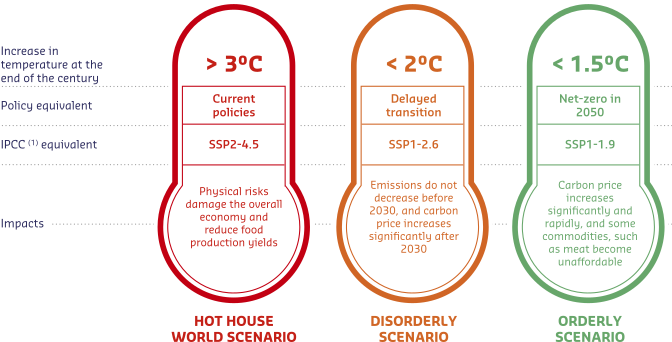
The diagram presents three climate warming scenarios based on projected temperature increases by the end of the century, along with their corresponding policies and measures:
1 – > 3°C
Overheated world.
Temperature increase: Above 3°C by the end of the century.
Government measures: Current policies.
IPCC(1) scenario: SSP2-4.5.
Impacts: Physical risks harm the global economy and reduce agricultural yields.
2 – < 2°C
Disorderly transition.
Temperature increase: Below 2°C by the end of the century.
Government measures: Gradual transition
IPCC(1) scenario: SSP1-2.6.
Impacts: Emissions do not decrease before 2030, and the carbon price rises sharply after 2030.
3 – < 1.5°C
Orderly transition.
Government measures: Net Zero by 2050.
IPCC(1) scenario: SSP1-1.9.
Impacts: The carbon price increases rapidly and significantly, and some commodities, such as meat, become unaffordable.
Based on this analysis, Sodexo chose to align its climate transition plan with the orderly scenario, which is scientifically credible, consistent with the Paris Agreement, and most relevant to the Group’s business model, global footprint, and stakeholder expectations. This scenario incorporates critical drivers such as evolving regulation (e.g. carbon pricing, deforestation-free supply chains), macroeconomic trends (e.g. food and energy price pressures), energy system transitions (e.g. electrification, renewable adoption), and technological developments (e.g. low-carbon kitchen equipment, digital emissions tracking). These factors directly influence Sodexo’s procurement strategies, service design, and long-term investment decisions.
The climate scenarios used are fully compatible with the critical assumptions underlying Sodexo’s financial statements. As outlined in section 2.2.2 of the consolidated financial statements, the potential long-term effects of climate-related risks, including those associated with supply chain disruptions, resource costs, and margin pressures, were integrated into the Group’s strategic planning, risk management processes, and impairment testing assumptions.
Extensive internal modelling and sensitivity analyses confirmed that Sodexo’s strategy is resilient under a 1.5 °C pathway, even though this scenario is the most ambitious and challenging to achieve. In particular, the modelling validated that expected changes in carbon pricing, demand for low-carbon services, shifts in dietary patterns, and required investments, such as those in carbon capture and storage post-2030, do not necessitate changes to asset useful lives, impairment assumptions, or carrying values at this stage.
This exercise also confirmed that the Group’s long-term financial plans remain robust and aligned with its Net Zero 2040 target. While climate change introduces uncertainties, the scenario analysis demonstrates that Sodexo’s strategic choices and operating model are compatible with a transition to a low-carbon economy and resilient under the most stringent global warming scenarios.
The findings from this analysis directly informed the development of Sodexo’s Net Zero 2040 strategy and the operational levers supporting it, including menu redesign, energy optimization, supply chain transformation, and greener logistics aimed at both reducing emissions and enhancing the long-term resilience of the Group’s business model.