
Resilience and adaptation to climate change [ESRS 2 SBM-3, E1-1 E1-3, E1-4]
Building upon the scenario analysis and the selection of the Orderly Transition pathway, Sodexo has identified a set of concrete decarbonization levers that are central to achieving our Net Zero 2040 ambition. These levers are not only aligned with the macroeconomic, regulatory, and technological assumptions of the selected scenario, but also represent actionable initiatives already underway across our operations and value chain.
To achieve our Net Zero 2040 ambition and ensure the business resilience of the Company, Sodexo has committed to reducing its carbon footprint in the near- and long-term, in alignment with the SBTi guidance for the Forest, Land-Usage and Agriculture (FLAG) sector. All below targets are science-based, compatible with limiting global warming to 1.5°C. and were validated by the SBTi. They are presented in absolute reduction targets compared to a 2017 baseline and, for Scope 2 emissions, we are using market-based figures.
In calculating our carbon footprint, Sodexo accounts for all relevant greenhouse gases included in the CO₂e metric, specifically carbon dioxide (CO₂), methane (CH₄), nitrous oxide (N₂O), and selected fluorinated gases (HFCs, PFCs, SF₆, NF₃). These gases are converted into carbon dioxide equivalents using the latest 100-year Global Warming Potential (GWP100) values published by the Intergovernmental Panel on Climate Change (IPCC), ensuring methodological consistency and scientific rigor. This approach is applied comprehensively across Scope 1, Scope 2, and Scope 3 emissions. By adopting this robust accounting framework, Sodexo ensures that its emissions reporting is transparent, comparable, and aligned with the SBTi. This enables the company to track progress credibly and supports its commitment to achieving Net Zero greenhouse gas emissions by 2040.
Mid and long-term objectives:
- by 2030, -55% total GHG emissions reduction, of which:
- - 55% Scope 1&2 GHG emissions reduction;
- no deforestation and conversion across primary deforestation-linked commodities;
-
-55% Scope 3 GHG emissions reduction, of which:
-
-40% Scope 3 Forest Land and AGriculture (FLAG) emission reduction.
-
- by 2040, Net Zero, of which:
- -90% Scope 1&2 GHG emissions reduction;
-
-90% Scope 3 GHG emissions reduction, of which:
-
-72% Scope 3 FLAG emission reduction.
-
To address identified risks and seize the business opportunities related to climate change, the climate transition plan was structured around three core pillars: responsible sourcing, sustainable eating, and on-site resource efficiency. Each pillar is linked to specific actions and initiatives designed to reduce emissions across our value chain. These actions are not only climate-mitigation measures; they also represent strategic adaptations to ensure Sodexo’s long-term resilience in a low-carbon economy. As Scope 3 emissions account for approximately 99% of Sodexo’s total footprint, these decarbonization levers are primarily designed to tackle upstream and downstream emissions across the value chain, where the greatest impact and reduction potential lie. These three pillars are now fully embedded into Sodexo’s strategic and operational planning as the primary levers for decarbonization and will enable Sodexo to reach its near- and long-term targets.
Sodexo Net Zero trajectory and decarbonization levers
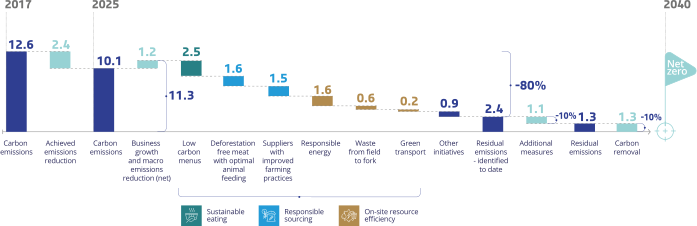
Sodexo Net Zero trajectory and decarbonization levers.
2017.
- Carbon emissions: 12.6 (total emissions).
- Emissions reductions achieved: 2.4 (actual reductions).
2025.
- Carbon emissions: 10.1 (projected 2025 emissions).
- Emissions reductions achieved: 2.5 (expected reductions).
- Net emissions (global emissions growth vs decline): 11.3 (overall impact including growth and reductions).
- Measures to reduce emissions.
- Low-carbon menus: 1.2 (reduction from offering low-carbon menu options).
- Responsible, deforestation-free meat sourcing: 1.6 (reduction from responsible meat supply).
- Suppliers with improved agricultural practices: 1.5 (reduction from more responsible farming).
- Responsible energy: 1.6 (reduction from cleaner energy use).
- Fork-to-fork food-waste reduction: 0.6 (reduction from responsible food-waste management).
- Green transport: 0.2 (reduction from low-impact transport).
- Other initiatives: 0.9 (additional reduction from other green initiatives).
2040.
- Net Zero by 2040: target achieved, shown with the “Net Zero” logo in the image.
- Other important information.
- Residual emissions identified to date: 2.4 (remaining after initiatives).
- Further residual emissions reduction:
- 80%: planned reduction of residual emissions.
- Additional measures: 1.1 (−10%) (extra reduction through additional actions).
- Residual emissions: 1.3 (residual total after all initiatives).
- Carbon removal: 1.3 (−10%) (removal of the final emissions).
To assess the effectiveness of these levers, we conducted a quantitative analysis of their carbon reduction potential. The results show that, if fully implemented, these initiatives can deliver over 80% of the emissions reductions required to meet our 2040 net-zero target. For the remaining 20%, we consider that:
- 10% reduction will be reached thanks to additional measures unidentified at this stage. Closing this gap will depend on collective action by governments, civil society, and the private sector to drive systemic changes in areas such as food production, dietary patterns, and energy infrastructure.
- remaining 10% will be reached thanks to carbon removal. In line with SBTi Net-Zero guidance, Sodexo intends to address residual emissions through the limited use of high-quality carbon removals generated beyond our value chain, whether natural or technological. The detailed strategy for these removals has not yet been finalized, as our current priority remains on emissions reduction and we are awaiting the updated SBTi guidance on removals.