
Scope 1, 2 & 3 GHG emissions accounting
To ensure accountability and continuous improvement, Sodexo tracks progress against its climate targets through defined KPIs, including GHG emissions (absolute emission and intensity), share of renewable electricity in the direct site operations, low-carbon meals, etc. Performance is reviewed annually with course corrections made when needed. Detailed results on GHG emissions and energy are presented in section below. In addition, Sodexo ensures transparency and progress tracking through EU Taxonomy disclosures, mapping economic activities to sustainability criteria and CapEx/OpEx alignment (refer to section 2.2.5 Green Taxonomy).
Sodexo does not directly derive revenues from activities related to coal, oil, or high-intensity power generation, and none of our operations have been identified as causing significant harm to environmental objectives under the EU Taxonomy.
Sodexo monitors and reports its GHG emissions in accordance with the GHG Protocol as well as the progress towards its climate-related targets.
GHG emissions footprint
For Sodexo, as a service provider operating primarily on client sites, the vast majority of greenhouse gas emissions fall within Scope 3. These emissions stem largely from purchased goods and services, particularly food, as well as upstream and downstream activities across our value chain. Addressing Scope 3 is therefore at the heart of our climate strategy, requiring close collaboration with suppliers, clients, and consumers to reduce impacts where they are most significant. By focusing on responsible sourcing, sustainable food offers, and operational efficiency, Sodexo tackles its largest emissions category while creating long-term value for stakeholders.
Locked-in GHG emissions mitigation
Sodexo has conducted a qualitative assessment of its potential locked-in GHG emissions. Given Sodexo’s asset-light business model, the company does not identify significant locked-in emissions that could jeopardize its GHG reduction targets or pose a transition risk. The primary sources of locked-in emissions include right-of-use assets, such as vehicles and office buildings, which are structured under relatively short-term agreements and gives the flexibility to adapt swiftly to emerging low-carbon technologies and mitigation strategies. While acknowledging the potential impact of locked-in emissions, Sodexo remains confident that its Climate Transition Plan will not be hindered, as the company’s operations do not rely on long-lived, carbon-intensive assets.
Scope 3 Indirect GHG emissions
Scope 3 includes indirect emissions from the value chain: upstream and downstream of Sodexo’s activities generated by various stakeholders: suppliers, consumers, service providers.
Scopes 1 & 2 Direct GHG emissions
Scopes 1 and 2 pertain to the company’s direct emissions and indirect emissions linked to the production of the energy used by the company.
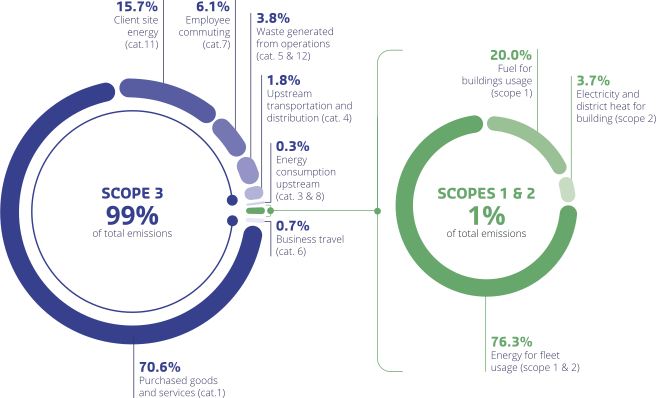
1 – Breakdown of emissions in Scope 3:
99% of total emissions come from Scope 3, represented by the central circle.
Breakdown by category:
- Purchase of goods and services (Cat. 1): 70.6% of emissions.
- Energy at client sites (Cat. 11): 15.7% of emissions.
- Employee commuting (Cat. 7): 6.1% of emissions.
- Waste generated by operations (Cat. 5 & 12): 3.8% of emissions.
- Upstream transport and distribution (Cat. 4): 1.8% of emissions.
- Upstream energy consumption (Cat. 3 & 8): 0.3% of emissions.
- Business travel (Cat. 6): 0.7% of emissions.
2 – Breakdown of emissions in Scopes 1 and 2:
1% of total emissions come from Scopes 1 & 2, represented by the central circle.
Breakdown by category within Scopes 1 & 2:
- Energy for building operations (Scope 1): 20.0% of emissions.
- Electricity and heating for buildings (Scope 2): 3.7% of emissions.
- Energy for vehicle fleet operations (Scopes 1 & 2): 76.3% of emissions.
The methodological note (in section 2.2.6 Reporting methodology) includes the main principles, including re-baselining procedures where applicable, and limitations retained for the calculation of Sodexo GHG emissions.