
The components of Sodexo’s total rewards encompass the full spectrum of compensation and benefits. They are tailored to different employee groups and adapted to local contexts and requirements.
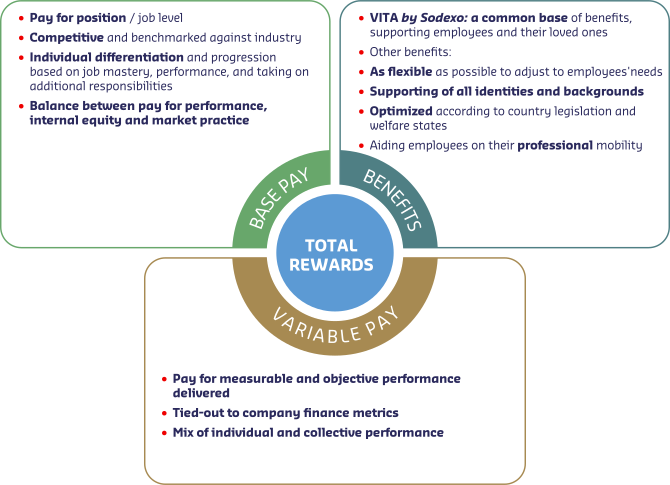
OVERALL COMPENSATION
BASIC SALARY
- Compensation based on position/level
- Competitive and aligned with industry practices
- Individual differentiation and progression based on mastery of the position, performance, and assumption of additional responsibilities
- Balance between performance-related compensation, internal equity, and market practices
BENEFITS
- VITA by Sodexo: a common set of employee benefits that supports employees and their families
- Other employee benefits:
- Tailored to employee needs as much as possible
- Supporting different identities and backgrounds
- Optimized in accordance with local regulations and social systems
- Supporting employees in professional mobility
VARIABLE COMPENSATION
- Rewarding measurable and objective performance
- Linked to the company's financial indicators
- Combining individual and collective performance
ADEQUATE WAGE [S1-10]
For this first year of CSRD implementation, we conducted a group-wide analysis of wages.
In Europe, employees benefit from labor laws and regulations that provide for a minimum wage or wages set by collective bargaining or unions agreements. Outside Europe, in all countries where Sodexo operates, employees benefit from a legal minimum wage and/or a collective bargaining agreement.
As of end of April 2025 (CSRD reference date), 100% of Sodexo employees receive fixed compensation (base salary plus guaranteed fixed allowances or equivalent), at or above applicable legal or collectively agreed minimums.
Given the number of countries in which the Group operates and the decentralized nature of its HR tools, the Group will continue to work on these topics to further refine its benchmark index analysis in the coming years.
Women and men are at the heart of the Group's business model. In addition to compensation, Sodexo invests to provide them with benefits which support their wellbeing. They must be tailored to the specific characteristics of the Group's employees and the regions in which they work. Initiatives are taken at group level or locally to best meet these needs. For example, the Vita program is progressively deployed since 2023 and shows tangible results: at the end of Fiscal 2025, 98% of countries where we operate provide a maternity leave ranging from 12 to 14 weeks at 100% pay, and more than 70% have fully implemented the Vita program across all its pillars.
This program is part of Sodexo’s commitment to fostering a workplace where everyone can live well and with dignity. Sodexo also invests in enhancing employees' employability by promoting continuous learning through its training programs, certifications and formal education that foster both technical and soft skills while ensuring they remain aligned with evolving industry trends.
GENDER PAY GAP [S1-16]
Non-discrimination is a cornerstone of the Group’s HR policy, which includes the application of non-discriminatory remuneration practices, notably regarding gender.
Convinced of the importance of continuous vigilance in advancing gender pay equity towards parity, the Group is actively engaged with its local teams to strengthen the analysis and monitoring of gender pay equity across all employee populations, both off-site and on-site. Annual compensation reviews (salary increases, free share grants) constitute key governance mechanisms for monitoring pay equity and reinforcing awareness among managers and HR teams. Strengthening collaboration between managers and HR in recruitment and promotion processes is an additional structured lever to ensure fair and equitable remuneration practices.
In this first year of CSRD implementation, given the complexity and decentralized nature of HR tools, the analysis was conducted across eight countries, covering around 80% of workforce, in accordance with the methodological note (see section 2.2.6.2.1, Adequate wage and remuneration metrics).