
6.3 Risk factors
6.3.1 Principal risks and risk management measures
Summary of Sodexo’s principal risk factors
The summary table of Sodexo’s principal risks shows a classification of the risks by reference to four categories, as well as risks from the external environment. As outlined in 6.2.4, each risk is assessed using impact and likelihood to give an evaluation of the inherent risk, and then a third criteria, level of control, is used to evaluate the overall net risk. The table below shows the net risk assessment. The most significant risks are presented at the top of each category, and the materiality of each risk shown is using a two-level rating scale (medium and high), as follows:
MAIN RISKS AND RISK MANAGEMENT
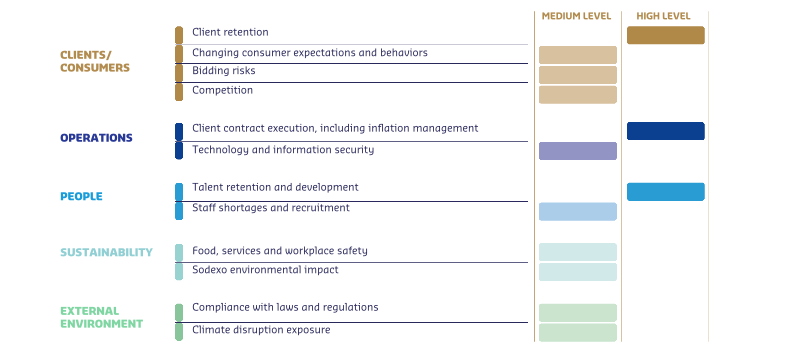
This image presents a summary table of risk levels across different business areas.
- Clients / Consumers
- Medium level:
- Assessing consumer expectations and behavior.
- Risks related to tenders.
- High level:
- Client retention.
- Medium level:
- Operations
- Medium level:
- Technology and IT security.
- High level:
- Execution of client contracts, including inflation management.
- Medium level:
- Employees
- Medium level:
- Staff shortages and recruitment.
- High level:
- Retention and talent development.
- Medium level:
- Sustainability
- Medium level:
- Basic safety, service safety, and workplace safety.
- Sodexo’s environmental impact.
- Medium level:
- External Environment
- Medium level:
- Risks related to legal and regulatory compliance.
- Exposure to climate change.
- Medium level:
Description of principal risk factors
The tables below describe Sodexo’s principal risk factors, their possible impact and give examples of measures implemented to reduce these risks.
|
CLIENT RETENTION |
Risk level: high |
|---|---|
|
CLIENT RETENTION Risk of not keeping and renewing contracts with Sodexo’s existing clients. |
|
|
CLIENT RETENTION Category: Clients/consumers |
|
|
CLIENT RETENTION Impact In order for Sodexo to continue to add value to its clients, and in turn consumers, there is a consistent need to understand – and then meet – their expectations. In a dynamic workplace, the need for innovation and continuous improvement means that Sodexo must regularly evolve and enhance the ways it supports its clients. An inability to adapt to each client’s specific circumstances or offer quality, innovative services could lead to Sodexo losing recognition as a strategic partner, resulting in:
|
Risk level: high Examples of mitigating activities
|