
2.2.1.4 Impact, risk and opportunity management
Description of the process to identify and assess material impacts, risks and opportunities [IRO-1]
The sustainability statement is grounded in a double materiality assessment carried out in 2024, encompassing Sodexo’s entire value chain, including its own operations as well as its upstream and downstream activities. This comprehensive approach ensures that both the impacts of sustainability matters on the company and the company’s impacts on people and the environment are fully considered.
Sodexo's double materiality assessment was conducted with the support of an external advisor, in accordance with ESRS and following a 4-step approach, engaging different governing bodies of the organization along the process. Senior Leadership Team was trained on CSRD during 2024, focusing on the double materiality principles and process. The Board of Directors' Audit Committee was involved early 2024, with a presentation of the CSRD requirements and high-level description of the implementation approach, and then in June 2024 to review and discuss the preliminary results of the double materiality assessment. Final results were approved by the Board of Directors in September 2024.
Double Materiality assessment in four steps
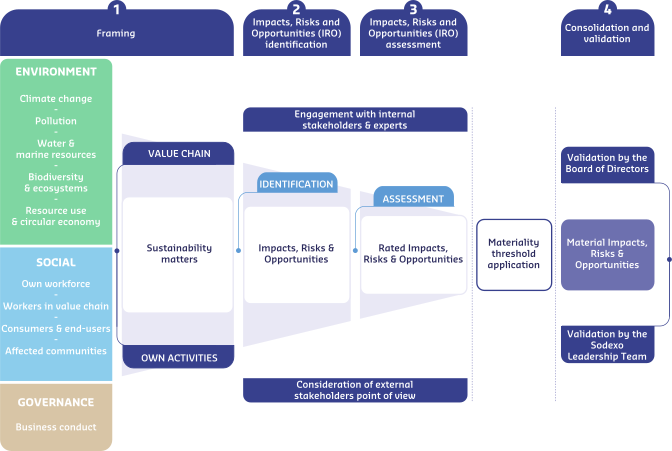
The diagram shows the four steps of a double materiality analysis, with key categories spanning environmental, social, and governance domains. The steps and domains are:
Section 1: Scoping
Environment
- Climate change.
- Pollution.
- Water and marine resources.
- Biodiversity and ecosystems.
- Resource use and circular economy.
Social
- Impacts of the company.
- Workers in the value chain.
- Consumers and end users.
- Affected communities.
Governance
Business conduct.
Value chain.
Sustainability issues.
Own operations.
Section 2: Identification of Impacts, Risks, and Opportunities (IRO)
Identification.
- Engagement with internal stakeholders and experts.
- Consideration of external stakeholders’ views.
Section 3: Assessment of Impacts, Risks, and Opportunities (IRO)
Assessment.
Impacts, risks, and opportunities evaluated.
Application of the materiality threshold.
Section 4: Consolidation and Validation
Validation by the Board of Directors.
Material impacts, risks, and opportunities.
Validation by the Executive Committee.
1. FRAMING
First phase aimed at defining the frame and project key milestones to ensure an efficient implementation approach. It included :
- value chain modelling to ensure that all activities and critical steps from raw material extraction (upstream) to end of life of product (downstream) are considered when performing the assessment;
- identification of sustainability matters applicable to Sodexo, based on the list of topics, sub-topics, sub-subtopics from regulatory requirements, through workshops, analysis of value chain, relevant documentation and benchmarking;
- identification of stakeholders based on the value chain modelling;
- definition of evaluation grids and methodology, capitalizing on existing Group risk evaluation grids and in accordance with regulatory requirements.
2. IMPACTS RISKS AND OPPORTUNITIES IDENTIFICATION
Based on document review, regulatory requirements and benchmark, a total of 68 impacts and 68 risks and opportunities have been identified, reviewed and validated by the relevant internal experts and representatives of all geographical zones who ensured the completeness and appropriateness of the IROs' description and rationale for identification, taking into account the specificities of food and non-food services, Sodexo's entire value chain and considering a time horizon up to 5 years.